
Guide to implementing a Climkit project
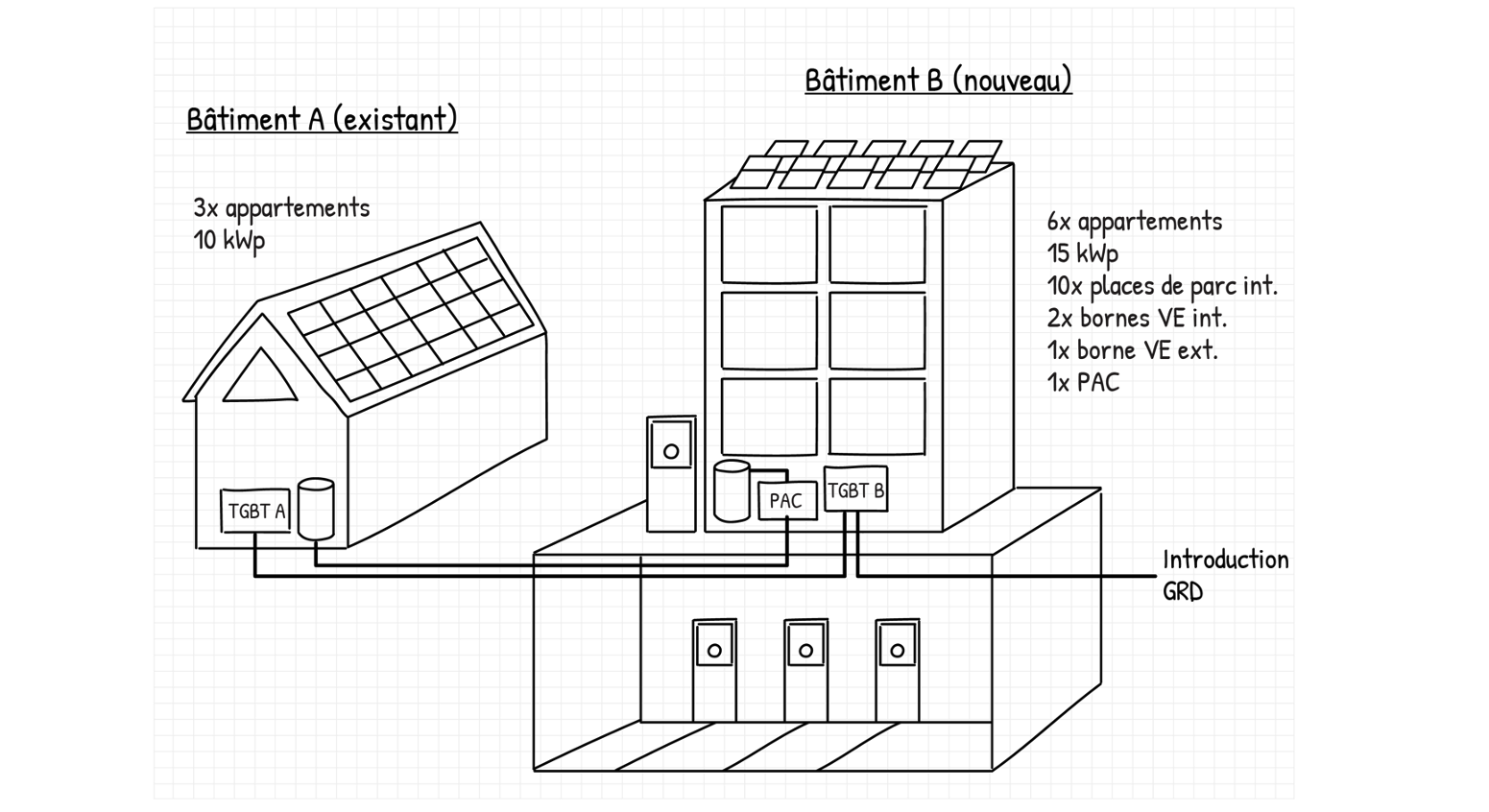
During our technical training this spring, we highlighted our methods and solutions through the presentation of a fictional project.
Project details
The project involves the renovation of an existing three-apartment building located at Chemin des Sourires 24 in Joieville, as well as the construction of a new six-apartment building on the adjacent plot. Here are some key points of our approach:
- Electricity and RCP: Installation of photovoltaic panels on both buildings for collective self-consumption. We also set up an electrical connection in the form of an RCP grouping, centralised from a single mains connection in the new building.
- Heating and statements: Installation of a heat pump in the new building and extension of the heating system to include the existing building. The new building is equipped with individual meters for accurate heating cost statements based on the individual heating cost accounting model (DIFEE).
- Electric mobility: Installation of two electric vehicle charging stations in the car park of building B, with a flat cable installation planned to make it easy to add further charging stations in the future. An outdoor "public" charging station lets visitors charge simply by paying with Twint. An emergency load-shedding management system, controlled by the distribution system operator (DSO), is also put in place.
- Collective laundry and eBike: We integrated our badge-accessible laundry management system, enabling the measurement and billing of the energy consumed. In addition, the bike room is equipped with six controllable sockets for charging electric bikes.
Monitoring and optimisation
All the equipment, supplied by Climkit, is connected to our online portal via a Climkit Gateway and a 4G router. This connectivity allows each resident to track their consumption in real time.
System objectives:
- Proactive monitoring: Real-time comparison of photovoltaic (PV) production data and weather conditions.
- Performance optimisation: Tracking the heat pump's efficiency and reducing consumption to meet the targets of ecological building labels such as Minergie and SEED.
- Energy autonomy: Dynamic management of the water heater and heat pump based on solar production.
Billing and statement management
After the equipment is installed, Climkit takes over the complete management of billing for the owner, ensuring precise individualisation of electricity consumption. This includes household electricity consumption, the use of the electric vehicle charging stations, the use of the laundry, and the charging of electric bikes.
For heating costs, the Climkit online tool allows the owner to generate personalised heating statements based directly on the actual consumption data of each apartment. This approach ensures complete transparency and enables a fair allocation of costs, contributing to better acceptance of charges by residents and more efficient management of the building's energy resources.
This project perfectly illustrates how to plan and carry out projects integrating Climkit solutions. We remain at your disposal to advise you on carrying out your own sustainable initiatives.